
SleepTwo Team
July 17, 2026 · 5 min read
Key insight
A monthly hormone shift quietly reshapes body temperature, REM sleep, and sleep onset for one partner — and often disrupts both. Here's what actually helps.
Are You Sleep Compatible?
Find out in 2 minutes — free
The Pattern Nobody Puts on the Shared Calendar
If one partner in your relationship menstruates, their sleep is running on a completely different hormonal script for roughly one week out of every month than it is for the other three. Most couples never connect the dots. They notice that certain weeks are rougher — more tossing, more waking, more short tempers at bedtime — and chalk it up to work stress or a bad patch, without realizing there's a monthly rhythm underneath it that a calendar app could have flagged in advance.
This isn't a minor footnote. Sleep researchers who track women across the menstrual cycle consistently find measurable changes in sleep architecture tied to specific hormonal phases, and because sleep is a shared environment for couples, those changes rarely stay contained to one side of the bed.
What Progesterone Does to Body Temperature
The luteal phase — roughly the two weeks between ovulation and the next period — brings a sharp rise in progesterone. Progesterone has a mild thermogenic effect, raising core body temperature by approximately 0.3 to 0.5 degrees Celsius. That might sound trivial, but sleep onset and deep sleep both depend on the body's core temperature dropping by a degree or two as bedtime approaches. A partner running warmer than usual is working against that cooling process every single night of the luteal phase, which shows up as lighter, more fragmented sleep and more nighttime awakenings — even with no change in stress, screen time, or bedtime routine.
Studies using polysomnography have found reduced sleep efficiency and less slow-wave sleep in the late luteal phase compared to the follicular phase earlier in the cycle. Subjectively, this is often the week women describe as "just not sleeping well," without an obvious cause.
The Days Right Before and During the Period
As progesterone withdraws sharply in the day or two before menstruation begins, the uterine lining releases prostaglandins — compounds that trigger cramping and, in the process, frequently cause waking during the night. This is a distinct mechanism from the temperature shift earlier in the luteal phase, and it tends to produce a different kind of disrupted sleep: sudden awakenings rather than generalized restlessness. Lower iron stores in the days following a heavier period can also contribute to fatigue and, for some, symptoms resembling restless legs.
Layered on top of the physical disruption is a mood component. PMS-related irritability and lower distress tolerance in the premenstrual window are well documented, and — just as with ordinary sleep deprivation — reduced prefrontal regulation during this phase makes minor evening friction more likely to escalate. A couple who doesn't recognize the timing can easily misread a rough week as a relationship problem rather than a predictable hormonal-and-sleep interaction that recurs, with variation, every month.
Why This Is a Shared-Bed Issue, Not a Solo One
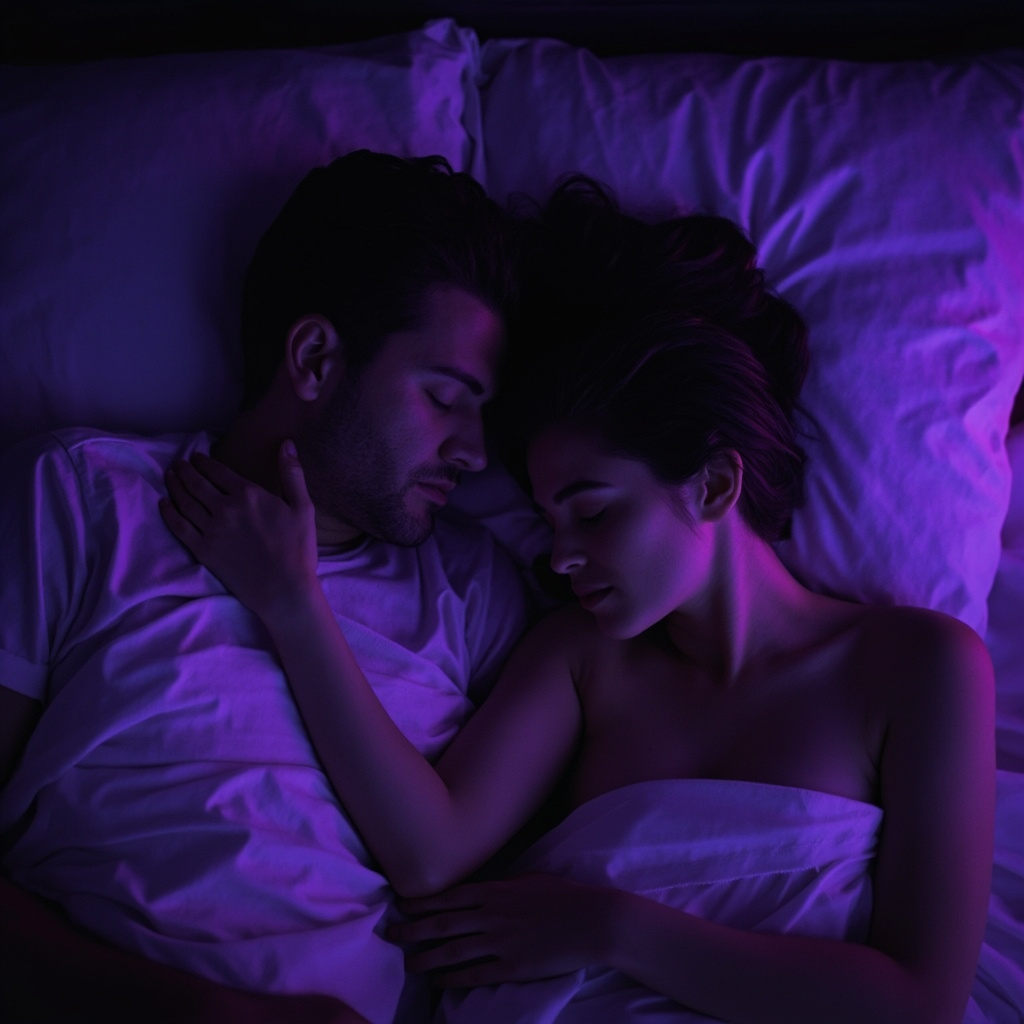
Because partners share a mattress, a duvet, and a thermal microclimate, one person's temperature swing becomes both people's problem. The warmer partner kicks off the covers; the other partner gets cold and pulls them back. One person shifts position more to manage discomfort; the other feels the mattress move. None of this requires snoring or obvious noise to fragment a partner's sleep — motion transfer and shared bedding do the job quietly.
There's also a relational upside to naming the pattern out loud. Partners who understand that a particular week is hormonally harder tend to respond with more patience and less confusion than partners left guessing why their usually even-tempered partner seems flat or edgy at 11pm for no apparent reason.
Four Things That Actually Help
Track cycle timing alongside sleep data. Once you can see that sleep efficiency and mood both dip in a predictable window each month, a rough night stops being a mystery and starts being something you can plan around — softer expectations, an earlier bedtime, no big conversations scheduled for 10pm.
Separate bedding during the luteal week. The Scandinavian approach of individual duvets removes the tug-of-war entirely and lets the warmer partner shed heat without leaving the other person cold. A cooling pillow or lighter sheet on one side of the bed accomplishes the same thing without a full bedding overhaul.
Watch evening alcohol and caffeine in the days before a period. Both already fragment sleep on their own; stacked on top of prostaglandin-driven waking and progesterone withdrawal, they tend to make a hard week noticeably harder.
Save loaded conversations for daylight. If prefrontal regulation is measurably lower in the premenstrual window, that's the week to move a difficult conversation to the morning rather than 10pm — not out of avoidance, but because both partners will have more capacity to handle it well a few hours later.
Start Tracking Tonight
A cycle-linked dip in sleep quality is easy to misread as random bad luck — or worse, as something one partner is doing wrong — until you can actually see the pattern. SleepTwo tracks both partners' sleep through Apple Watch and shows a nightly compatibility score, so a recurring rough patch shows up as data instead of a guessing game, and you can tell the difference between a one-off bad night and a predictable monthly rhythm. Download free on the App Store — Together Pro covers both partners. sleeptwo.app
Research & further reading
- Sleep Deprivation and Deficiency— NIH / NHLBI
- Stages of Sleep— Sleep Foundation
- How Much Sleep Do We Really Need?— Sleep Foundation
Stop guessing. Start knowing.
SleepTwo gives couples a real 0–100 compatibility score every morning — based on actual sleep data, not a quiz. Free to download. One subscription covers both of you.
iOS 17+ · iPhone mic or Apple Watch · Free download