
SleepTwo Team
June 23, 2026 · 5 min read
Key insight
Sleep talking wakes both partners and raises uncomfortable questions. Here's what science reveals about somniloquy and how couples protect their shared rest.
Are You Sleep Compatible?
Find out in 2 minutes — free
The Voice in the Dark
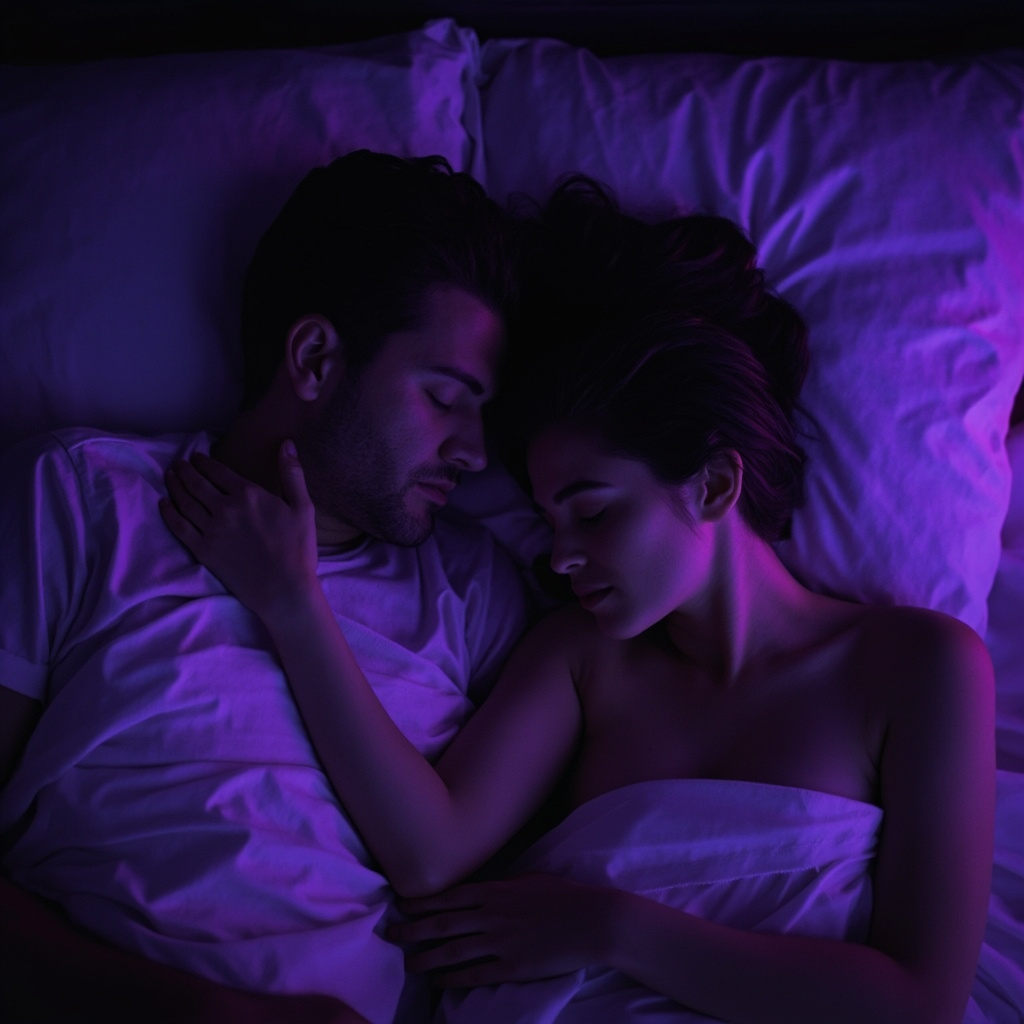
Most couples discover sleep talking the same way: one partner is jolted awake at 2 am by something the other says — a fragment of a sentence, a mumbled response to a dream conversation nobody else is part of, occasionally something emotionally charged enough to demand explanation in the morning. The talker remembers none of it. The listener remembers all of it.
Sleep talking, known medically as somniloquy, is more common than most people realise. Research has documented it in approximately 66 percent of children and around 5 percent of adults, though the actual prevalence is likely higher since many episodes go unwitnessed or unreported. For couples who share a bed, one partner's somniloquy is reliably the other partner's sleep disruption — a nightly event that often goes unaddressed because neither person is sure what it means or what, if anything, to do about it.
What Sleep Talking Actually Is
Somniloquy is classified as a parasomnia — a category of sleep disorder covering unwanted behaviours during sleep. It can occur during any stage of sleep, but the content and character of sleep talking varies considerably depending on when in the night it happens.
Sleep talking during NREM sleep — particularly the lighter Stage 2 and the deeper slow-wave sleep of Stage 3 — tends to be vague, low in coherent content, and more likely to involve sounds, fragments, or confused utterances. A partner who seems to be having a conversation at 11:30 pm is probably in a lighter NREM stage and producing speech that corresponds to very little coherent mental activity.
Sleep talking during REM sleep — the dreaming stage — can be dramatically different. Because the brain during REM is highly active, generating vivid narrative experiences, speech that emerges in REM tends to sound more purposeful. Complete sentences, expressed emotions, and responses to dream-world conversations are all characteristic of REM somniloquy. This is the kind of sleep talking that raises questions the following morning.
Research on somniloquy has documented that the content of REM sleep talking is related to, though not a direct transcript of, dream content. The words that come out do not reliably represent thoughts or feelings the sleeping person would express while awake, and they cannot be used as evidence of subconscious feelings or unresolved relationship issues.
Why One Partner Talks and the Other Doesn't
Sleep talking has a genetic component. Studies using twin pairs have found higher concordance rates for somniloquy in identical twins than in fraternal twins, suggesting a heritable susceptibility. This is why some people sleep-talk their entire lives without any identifiable external trigger, while their partner has never done it once.
Several factors reliably increase the frequency of sleep talking in susceptible individuals:
Sleep deprivation is one of the most consistent triggers. When a person is sleep-deprived, the brain's transitions between sleep stages become less stable. This instability can cause vocal activity to break through stage transitions more easily. A partner who sleep-talks significantly more during stressful or busy weeks may simply be showing the effect of accumulated sleep debt rather than anything emotionally meaningful.
Fever and illness elevate core body temperature in ways that destabilise sleep architecture, producing more parasomnia activity including sleep talking. The partner who speaks during sleep while ill is having a physiologically abnormal night — not a psychologically revealing one.
Alcohol also increases the frequency and intensity of sleep talking in many people. It alters the architecture of sleep stages — suppressing REM early in the night and then producing a rebound of REM activity in the second half — which destabilises stage transitions in both directions and creates more opportunity for vocal episodes.
The Couple-Specific Challenge
For the partner who does not sleep-talk, the main problem is straightforward: being woken up. A single clear utterance at 3 am causes an arousal that can take 20 to 30 minutes to resolve, cutting into the deep sleep or REM sleep that both people need for the following day. Over a week of disrupted nights, this adds up to measurable sleep debt in the non-talking partner — even when the talker wakes feeling fine.
There is also an emotional dimension that solo sleepers never face. Sleep talk can be emotionally charged — anxious, affectionate, accusatory, or simply confusing. A partner who hears their name spoken with urgency in the dark, or who overhears what sounds like an argument they are not part of, has to make sense of something with no coherent explanation. The impulse to interpret sleep talking as meaningful disclosure about the relationship is extremely common and almost always misleading.
Research on REM somniloquy is clear on this point: speech produced during dreaming cannot be treated as a direct expression of waking thoughts or feelings. The dream state generates a narrative driven partly by the hippocampus and limbic system, with motor inhibition temporarily reduced — but the speech that results reflects dream logic, not waking belief. What is said in sleep is not a confession.
Four Practical Approaches for Tonight
Track the pattern first. Sleep talking that is infrequent and brief is rarely worth treating. The first step is establishing whether it is genuinely disrupting the non-talking partner's sleep or is a curiosity that rarely causes waking. A week of data provides this baseline — does the listener show fragmented sleep, reduced deep sleep duration, or elevated overnight heart rate on nights when episodes are more frequent?
Address the modifiable triggers. If sleep talking tracks with stress, late nights, or alcohol consumption, the intervention is upstream. A partner who stops sleep-talking when adequately rested and alcohol-free is not showing a condition that requires clinical attention — they are showing a normal response to better sleep hygiene. Managing these variables together gives both partners agency over a problem that previously felt one-sided.
Let the episode settle rather than responding to it. When the non-talking partner is woken, the instinct to respond verbally — asking what is wrong, or gently waking the talker — almost always prolongs the episode. Engaging a sleep-talker typically increases the duration of the episode or causes more disruption. A soft, gentle touch to settle the person, or simply waiting for the episode to pass, is more effective than attempting to communicate.
Distinguish somniloquy from REM Sleep Behavior Disorder. Occasional sleep talking is benign. Sleep talking accompanied by active physical movement — sitting up, reaching, attempting to get out of bed, or appearing to physically act out a scenario — may indicate REM Sleep Behavior Disorder (RBD), a condition in which the normal muscle paralysis of REM sleep fails to occur. RBD has a different and more significant clinical profile than simple somniloquy and warrants medical evaluation rather than home management.
Start Tracking Tonight
SleepTwo tracks both partners' sleep via Apple Watch every night, giving you the data to see whether sleep talking is genuinely affecting your non-talking partner's sleep stages, HRV, and overnight heart rate — or whether it sounds more disruptive than it actually is. Your nightly compatibility score shows how well your rhythms aligned, and nights when one partner's sleep architecture is fragmented by parasomnia activity leave a recognisable signature in both partners' data. Understanding the pattern is the first step toward addressing it together. Download free on the App Store — Together Pro covers both partners. sleeptwo.app
Research & further reading
- Insomnia— Sleep Foundation
- Sleep Disorders— NIH / NHLBI
Stop guessing. Start knowing.
SleepTwo gives couples a real 0–100 compatibility score every morning — based on actual sleep data, not a quiz. Free to download. One subscription covers both of you.
iOS 17+ · iPhone mic or Apple Watch · Free download